5 ESL Earth Day Activities That Build Vocabulary, Grammar & Writing
April brings Earth Day—a time when people around the world come together to celebrate our planet and think about how we can take better care of it. It’s a meaningful opportunity to talk about real-world issues like protecting nature, reducing waste, and making small changes that matter. For ESL learners, this kind of seasonal topic makes language learning more relevant and engaging. The key, however, is choosing activities that offer enough structure to support vocabulary, grammar, and writing—without overwhelming them.

Here are five simple classroom ideas that naturally integrate language learning with Earth Day themes.
Disclaimer: In this blog, the terms ESL students (English as a Second Language), ELLs (English Language Learners), and ML (Multilingual Learners) are used interchangeably. While “Multilingual Learners” is becoming the more widely accepted term, “ESL students” and “English Language Learners” are still commonly used in various contexts. My aim is to be inclusive and clear to all readers, regardless of the terminology they are familiar with.
1. ESL Earth Day Sentence Building Activities for Grammar Practice
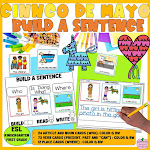
One effective way to build grammar skills is through structured sentence-building activities that give students hands-on practice with language. Students work with color coded word cards representing different parts of a sentence—such as the subject (Who?), verb (What?), and location (Where?)—and physically arrange them to create complete sentences like “The boy is picking up trash.” This tactile approach helps learners clearly see how sentences are formed and how each part contributes to meaning.

After building their sentences, students read them aloud to practice fluency and then write them down, reinforcing both grammar and sentence structure. These activities focus on key patterns such as subject + “to be” + verb + -ing (present continuous tense), giving students repeated, meaningful exposure to this structure in context.
To deepen learning, teachers can extend the activity by asking students to expand their sentences—for example, adding when (on Earth Day, in April) or why (to protect the planet). This encourages more complex thinking while still maintaining clear support.

These sentence-building tasks are flexible and work well in centers, independent practice, or small group settings. Most importantly, they allow students to practice multiple skills at once—vocabulary, grammar, and sentence structure—while staying grounded in a meaningful and engaging theme like Earth Day.
2. ESL Earth Day Vocabulary Activities: Think, Label, Trace, and Write
To support vocabulary development and early writing, students begin with the Picture Word Inductive Model (PWIM), a strategy that uses images to build language. In PWIM, students look closely at a picture, identify what they see, and label it with words, helping them connect visuals to vocabulary in a meaningful way.

They then reinforce these words by tracing them across themed pages, such as “Earth Day: Where,” “Earth Day: When,” “Earth Day Kids,” and “Earth Day Action Verbs.” Students also complete picture sorts, focusing on nouns and verbs, and match images to words to strengthen their understanding.

Once students have acquired or reviewed essential vocabulary, they begin writing simple sentences, using their completed pages as guides and word banks. This gradual progression helps them move from recognizing vocabulary to using it independently in sentences and short paragraphs.

The unit also includes anchor charts, such as 5W (Who, What, When, Where, Why) and Beginning–Middle–End organizers for both nonfiction and fiction writing. Students use these supports to form simple sentences, for example: Who—kids; What—clean parks, beaches, forests, plant saplings; When—in April or on April 22; Where—parks, forests, beaches; Why—to protect our planet. These visual scaffolds provide clear structure and help students confidently organize and express their ideas in writing.
3. ESL Earth Day Craft with Writing (Build Vocabulary & Sentences)
In this activity, students complete a simple Earth Day craft, such as a coloring or cut-and-paste project, and then add a sentence about their work. For example, they might write “I help the Earth by planting trees.” This combines creativity with purposeful writing and encourages personal connections.

4. ESL Earth Day Reading and Writing Activities with Printable Booklets
Students read short, supported passages about Earth Day and complete related writing tasks. These might include finishing sentences or answering simple questions. This helps reinforce vocabulary in context while building both comprehension and writing skills.

5. ESL Earth Day Vocabulary Practice with Puzzles, Coloring & TPR Activities
Students complete activities such as color-by-word, vocabulary matching, or simple listening-based coloring tasks. These provide additional exposure to key vocabulary in a more relaxed format, which is especially helpful for visual learners.

Earth Day activities don’t need to be complicated to support language development. With clear structures, visual supports, and opportunities to practice across speaking, reading, and writing, students can build both confidence and language skills in meaningful ways.
5. Celebrate your Students' Efforts with Fun Earth Certificates
Celebrate your students’ efforts all month long by recognizing their positive actions with fun and meaningful Earth Day certificates. Whether they are recycling, turning off lights, helping clean up their classroom, or learning how to care for nature, these certificates provide a simple way to acknowledge their contributions.

With a variety of awards—such as Earth Hero, Trash Sorting Superstar, Eco-Champion, Green Guardian, Planet Protector, and even Tree Hugger Honor—every student has the opportunity to feel proud of the role they play in protecting the planet. You can award them daily or weekly throughout April to keep motivation high and reinforce Earth Day habits. These small moments of recognition not only build confidence but also encourage students to continue making environmentally responsible choices both in and out of the classroom.

If you are looking for more April themed activities/ ideas for ELLs, check out this blog post!.
Would you like to get more freebies, exclusive deals, ESL tips, crafts, and classroom culture ideas? Sign up for my weekly newsletter!



























0 Comments