The beginning of April is a wonderful time to bring seasonal themes, vocabulary, and cultural traditions into your ESL classroom. From April Fool’s Day ESL activities to Easter vocabulary, ESL morning meeting slides, and engaging speaking and writing routines, this time of year offers many opportunities to build language skills in meaningful ways.

Here is a round-up of meaningful ESL resources for the beginning of April that support listening, speaking, reading, and writing while keeping students engaged.
Disclaimer: In this blog, the terms ESL students (English as a Second Language), ELLs (English Language Learners), and ML (Multilingual Learners) are used interchangeably. While “Multilingual Learners” is becoming the more widely accepted term, “ESL students” and “English Language Learners” are still commonly used in various contexts. My aim is to be inclusive and clear to all readers, regardless of the terminology they are familiar with.
1. April Fool’s Day ESL Activity: Listening and Following Directions
April Fool’s Day is a fun holiday celebrated in many countries such as the United States, Canada, the United Kingdom, Australia, and France. On this day, people play small, harmless jokes called pranks.
For students who are not familiar with this holiday, you can introduce the concept by explaining what a prank is and sharing a simple classroom example.
This April Fool’s Day ESL activity also strengthens listening comprehension and test-taking skills.
This engaging Following Directions Listening Challenge uses a playful test prank to help English Language Learners practice listening carefully, following oral directions, and thinking before starting a task.

Students listen to a series of teacher-read directions and follow them by coloring parts of a funny April Fool’s scene and completing simple TPR actions. The surprise final instruction reveals that students were supposed to listen to all directions before beginning.
The activity leads to meaningful discussions about listening strategies, attention to instructions, and successful test-taking habits.
2. ESL Morning Meeting Slides and April Calendar Routine
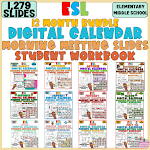
Your ESL morning meeting slides and calendar routine are a great way to introduce April themes and seasonal vocabulary.

By April, your ELLs are usually familiar with this routine. Let them help build the calendar pattern by moving Easter eggs and bunny tiles to create patterns.

You can also:
- Discuss the daily weather
- Begin building a weather graph
- Introduce or revisit the traditions of the Easter Bunny and Easter egg hunts
- Frontload important seasonal vocabulary

To make the routine more interactive, you can also play a quick April-themed “Would You Rather?” game during morning meeting.
3. Building Background Knowledge with PWIM and See–Think–Wonder
Another meaningful way to introduce April and Easter themes is by building background knowledge using PWIM (Picture Word Inductive Model) and the See–Think–Wonder routine.

Use the Gradual Release of Responsibility Model or I do, We do, You do routine:
- I do: Model how to label an April-themed image.
- We do: Practice shared writing using the labels and sentence starters.
- You do: Students apply the vocabulary independently.
You can also include April-themed noun and verb word sorts to reinforce vocabulary.

Finally, let students use their imagination and the visual word bank to write their own stories using who / what / where prompts.
Your newcomers can simply order and glue sentence pieces to build their ideas.
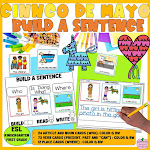
4. April-Themed Build-a-Sentence Activities for ESL Grammar
Build-a-sentence activities are a great way to reinforce sentence structure, grammar, and vocabulary.
Students first build a sentence using three types of color-coded cards, and then rewrite it on paper.
This is also a great opportunity to build background knowledge around the American tradition of Easter egg hunts.

Students can create sentences using:
- Present continuous cards
- Modal “can” cards
- Past tense cards
Example sentence:
The girl is looking for eggs in the garden.
These activities are also great for strengthening verb–noun collocations and helping students practice natural chunks of language. These activities are great for centers or independent work and can give you time to work one-on-one with your newcomers.
5. Easter Vocabulary Game: Nouns and Verbs “I Have, Who Has?” and Write the Room Games
You can also reinforce Easter vocabulary with a fun and engaging “I Have, Who Has?” vocabulary game.

Choose a student to start the game. The student reads their card aloud and says:
“I have "basket". Who has Easter Bunny?”
The student who has the correct card responds and continues the chain.
This activity reinforces Easter vocabulary, listening skills, and speaking confidence while keeping the classroom energy high.
Another fun vocabulary activity is Easter Write the Room. Students walk around the classroom to find Easter-themed vocabulary cards and write the words on their recording sheet. This activity gets students moving while practicing reading, spelling, and recognizing seasonal vocabulary.

From April Fool’s Day ESL listening activities to Easter vocabulary games, build-a-sentence practice, and ESL morning meeting slides, the beginning of April offers many opportunities to create engaging language experiences for your students.
These seasonal routines help students:
- build vocabulary
- strengthen listening skills
- practice grammar and sentence structure
- develop cultural understanding
And most importantly, they bring fun and meaningful learning into the ESL classroom.

Would you like to get more freebies, exclusive deals, ESL tips, crafts, and classroom culture ideas? Sign up for my weekly newsletter!































0 Comments