Valentine’s Day is one of my favorite times to build engagement in the ESL classroom. The theme naturally encourages communication, creativity, and connection — which makes it perfect for developing oral language, vocabulary, grammar, listening, and writing skills in meaningful ways.

If you’re looking for low-stress, high-engagement ESL Valentine’s Day activities, here are some ideas that work beautifully across proficiency levels — especially for newcomers and emerging bilingual students.
Disclaimer: In this blog, the terms ESL students (English as a Second Language), ELLs (English Language Learners), and ML (Multilingual Learners) are used interchangeably. While “Multilingual Learners” is becoming the more widely accepted term, “ESL students” and “English Language Learners” are still commonly used in various contexts. My aim is to be inclusive and clear to all readers, regardless of the terminology they are familiar with.
1. Build Oral Language, Listening, and Vocabulary First
Before jumping into writing, I always start with building oral language and vocabulary. ESL students need strong language foundations before they can successfully express ideas in writing.

One of my favorite strategies is using Valentine’s Day themed images. Try This:
- Show Valentine’s Day pictures
- Brainstorm vocabulary using the PWIM (Picture Word Inductive Model) and /or See-Think-Wonder routine
- Practice speaking and listening together
- Teach verb + noun collocations (ex: give a card, share candy, write a note)
After brainstorming vocabulary, move into shared writing. Model how to create a simple Valentine’s story with a clear structure: Beginning: One day… or On Valentine’s Day…/Middle: What happened? Ending: How did it finish? /Feelings.

For newcomers, tracing, labeling pictures and having a simple sentence starter (I see ...) is incredibly helpful before they attempt independent writing. This builds confidence while reinforcing vocabulary and sentence structure.
2. Use Sentence Building Centers to Support Grammar and Writing
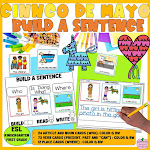
Our ESL newcomers and emergent writers thrive on routines and structure. That’s why I absolutely love using Build a Sentence Centers during Valentine’s Day. Students create themed sentences using picture cards that follow a predictable pattern: Who + What + Where.

These centers are fantastic for mixed proficiency levels because:
- Cards include picture labels
- Visual supports help newcomers succeed
- Color-coded cards reduce frustration (who-red border, what-blue border and where -green border)
- Students feel confident and independent
While newcomers build and record their sentences, you can pull small groups to target grammar instruction. Depending on student needs, this is a great time to practice: Present simple tense, Past tense verbs, Modal verb can for ability. It’s differentiated, engaging, and stress-free — the perfect Valentine’s Day combination!
3. Play ESL Valentine’s Vocabulary Games
Games are one of the best ways to reinforce ESL vocabulary and listening skills while keeping students motivated.
Valentine Vocabulary Scavenger Hunt
Hide Valentine’s Day vocabulary cards around the room. Students search for the cards and record their words. You can differentiate this game easily:
- Newcomers: Trace the vocabulary words
- Beginner & Intermediate: Write the word using picture clues
- Advanced Students: Record words independently

This activity also works well for practicing phonics and initial letter sounds, especially for younger learners. As an extension, students create a one-page book about St. Valentine’s Day, listing people, gifts, food, and decorations.
“I Have, Who Has?” Listening Game
This interactive game strengthens: listening comprehension, speaking fluency, vocabulary recognition and classroom collaboration.

If you teach younger ESL students, try an alphabet version to reinforce foundational literacy skills.

4. Try Listen, Draw, Act, and Giggle Activities
Another activity that is always a classroom favorite is Listen, Draw, Act, and Giggle because it combines listening, movement through Total Physical Response (TPR), and drawing in a fun and meaningful way. This type of ESL listening activity helps students build active listening skills while practicing how to follow multi-step directions.
It also strengthens fine motor skills, expands oral language development, and improves memory and comprehension since movement helps students retain information. An added bonus for teachers is that this activity requires very little prep.

To use it, simply give each student a worksheet and read the directions aloud one step at a time. Students listen carefully and complete the drawing actions as they follow along. The directions can easily be shortened or adjusted depending on student proficiency levels. These Valentine-themed coloring pages include acting directions such as pretending to give a Valentine hug, unlocking a gift box, or delivering Valentine cards. Students truly love the movement, creativity, and laughter that come with this activity.
5. Celebrate Valentine’s Day Around the World

Make Valentine’s Day Meaningful for ESL Students

Would you like to get more freebies, exclusive deals, ESL tips, crafts, and classroom culture ideas? Sign up for my weekly newsletter!































0 Comments