January ESL Activities for Winter: Meaningful SEL, Literacy & Engagement for English Language Learners
Helping Our ELL Students Get Back on Track
January can feel hard — for students and teachers. After the excitement of winter break, it’s normal for motivation, routines, and focus to slide a little. For our English Language Learners, that slide can feel even heavier.

Disclaimer: In this blog, the terms ESL students (English as a Second Language), ELLs (English Language Learners), and ML (Multilingual Learners) are used interchangeably. While “Multilingual Learners” is becoming the more widely accepted term, “ESL students” and “English Language Learners” are still commonly used in various contexts. My aim is to be inclusive and clear to all readers, regardless of the terminology they are familiar with.
That’s why the beginning of January is the perfect time to slow down, reconnect, and intentionally bring our ELL students back into learning with activities that support SEL, language development, and confidence.
Here are some meaningful, classroom-tested ideas to start your year strong.
1. Start with SEL: Winter Feelings Check-In for ELLs
Before diving into academics, it’s important to check in with students and see how they are doing — socially, emotionally, and mentally. When students feel seen and safe, learning happens more naturally.
Your newcomers can point to the snowman feelings in their workbook, or they can start by coloring the feeling that matches how they feel today.
Provide simple sentence frames such as: Today I feel ___ because ___.

For older students, I use feeling faces for this activity. Students can color images and practice choral reading the feeling words after you, or they can trace, color, and read or use the word bank to label feelings.
This activity is not only great for SEL, but it also teaches your students emotions vocabulary, which becomes very useful later when they begin describing characters’ feelings in the ELA / literacy block.
2. ESL Winter Break Writing: Reflection That Builds Language & Confidence
Another activity that helps check in with your students — while also practicing vocabulary and writing — is the “What I Did Over Winter Break” activity.
This no-prep winter writing resource helps students ease back into learning after winter break by encouraging them to reflect, write, and draw about their winter and Christmas break experiences using structured prompts, visual word banks, and differentiated writing pages.

It is perfect for January back-to-school, morning work, literacy centers, early finishers, or writing workshops, and it supports students at many ability levels while keeping writing fun and meaningful.
In this activity I provide my students with visual word banks aligned to four winter break writing prompts. This scaffold is perfect for emergent writers, struggling writers, and ESL students that helps them generate ideas and build sentences independently.
Students have several engaging options when completing the "What I did over winter break snow globe activity. With the One-Page Snow Globe Writing Craft, students write one sentence about their winter break, draw a matching picture, cut out the snow globe, color it, and display their work. This version includes six different formats — primary lines, regular lines, sentence starters, dotted sentence starters, and blank lines — making it easy to differentiate for all learners.
The One-Page Snow Globe Writing Sheet allows students to write using prompts and draw their picture directly inside the snow globe, and it also includes the same six differentiated versions.
For a more in-depth project, the Snow Globe Shaped Writing Craft (Multi-Page) lets students create a snow globe book with a cover page and four inside pages aligned to winter prompts, again offered in six differentiated formats to support a wide range of student needs.
If you need more goals setting activities for ELLs such as New Year's Resolutions check out this blog post!
3. January ESL Focus: Winter Vocabulary & MLK Jr.
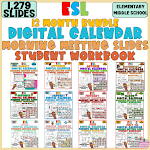
January is a perfect month to focus on winter themes and winter vocabulary. I introduce winter nouns and verbs in my morning slides, and students practice labeling, tracing, matching, and reading them in their workbooks.

January also includes Martin Luther King Jr. Day, so we take time to introduce this important holiday and learn academic vocabulary such as speech, protest, segregation, and civil rights.

4. ESL Grammar Focus: Building Verb Tense Understanding
In our grammar workshop, we focus on verbs and tenses. Students sort visual verb tense cards into past, present, and future. With beginner and intermediate students, I also introduce the difference between present continuous and present simple.

We study key signal words that help students choose the correct tense:
- Present Continuous — now, at the moment, look
- Present Simple — sometimes, often, never, always (for routine actions).


5. ESL K–2: Labeling, Tracing & PWIM for Winter Writing
With my K–2 students, we focus on labeling, tracing, and sorting.

We use PWIM (Picture Word Inductive Model) to describe winter scenes, and students write simple winter stories using the vocabulary we’ve built together.
5. Grades 3–8: Small Moment Winter Writing
With grades 3–8, we write small moment winter stories using a mentor text. Students emulate writer’s moves such as:
- Sound words (onomatopoeia)
- Dialogue
- Strong leads
- Internal thinking
- Endings with feelings
- This builds both writing craft and language confidence.

6. Add Movement & Gamification: Winter ESL Games


Would you like to get more freebies, exclusive deals, ESL tips, crafts, and classroom culture ideas? Sign up for my weekly newsletter!

























0 Comments