New Year’s Resolutions in the ESL Classroom: Small Goals, Big Impact
I recently started reading Atomic Habits by James Clear, and it has stayed with me as I plan for the new year. One of his central ideas is that small habits shape nearly every area of our lives -our health, our learning, our finances, and even our relationships. Real change, Clear explains, doesn’t come from dramatic resolutions, but from tiny, intentional actions repeated consistently over time.

Disclaimer: In this blog, the terms ESL students (English as a Second Language), ELLs (English Language Learners), and ML (Multilingual Learners) are used interchangeably. While “Multilingual Learners” is becoming the more widely accepted term, “ESL students” and “English Language Learners” are still commonly used in various contexts. My aim is to be inclusive and clear to all readers, regardless of the terminology they are familiar with.
This way of thinking is incredibly powerful in education. When we shift the focus from motivation to systems, structure, and achievable steps, students are far more likely to succeed. As teachers, this perspective feels especially relevant when we think about our students - and even more so when we consider the needs of our English language learners, who benefit most from clear routines, strong scaffolds, and goals that feel possible from the very start.
You can read more about the book and its core ideas here.
This mindset is exactly why I continue to use New Year’s resolutions as a learning experience in my ESL classroom. When goal-setting is broken down, scaffolded, and made visual, it becomes accessible to students at all proficiency levels. Instead of asking students to write long resolutions they may not yet have the language for, we focus on small goals, clear choices, and supportive structures—the same principles Atomic Habits encourages.
For teachers, this approach is a helpful reminder as well. Rather than setting unrealistic classroom or personal goals for the new year, we can focus on one or two systems that support growth—clear routines, consistent language practice, or activities that empower students to make choices. When we model this mindset, students learn that progress happens step by step.
Why New Year’s Resolutions Matter for ESL Students
Creating New Year’s resolutions in the ESL classroom is about much more than writing. It gives students an opportunity to reflect, build self-awareness, and use language in a meaningful, personal way. For English learners, this is especially powerful because it connects vocabulary and sentence structures to real life.

In my classroom, we focus on three types of goals: social, academic, and personal. This framework helps students understand that learning is not only about schoolwork—it’s also about relationships and taking care of themselves. These categories stay consistent across grade levels, but the way students interact with them changes depending on their language development.
K–1 ESL Students: Visual, Hands-On, and Developmentally Appropriate
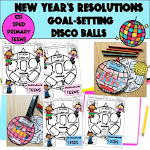
For my K–1 ESL students, goal-setting needs to be concrete and highly visual. Students trace, cut, and paste goal picture cards such as eat more vegetables, sleep longer, or make new friends. Each goal includes a label, and students sort and place it under the correct heading - social, academic, or personal - before gluing it down.

Once the inside page is complete, students color their disco ball cover and staple the pages together to create a finished project. This process supports fine motor development while also reinforcing vocabulary and category concepts. Most importantly, it gives students choice. They are not being told what their goals should be; they are selecting goals that make sense to them.
This is especially effective for ESL newcomers and emergent K–1 learners because it removes the pressure of producing language independently while still allowing students to engage in meaningful reflection. Activities like cutting, gluing, tracing, and coloring keep students engaged while language learning happens naturally.
ESL Grades 2–8: The Same Goals, Stronger Language Scaffolds
I use the same resource with my students in grades 2–8, but at this level, students are given more responsibility with the support of a visual word bank. ESL students and emergent writers use the word bank to help them write their resolutions, copying phrases and building confidence with sentence structure and spelling.

ESL New Year’s Resolution Crowns for K–1
With my younger students, we sometimes extend this idea by creating New Year’s Resolution crowns. The concept stays the same, but students choose how much language support they need.


I update these resources every year, so once you own them, you can simply re-download the new year’s version for free and continue using them with new groups of students—refining the system, not reinventing it.
Small goals. Clear systems. Real growth.
That’s a resolution worth keeping—for teachers and students alike.

Need more teaching ideas for January? Check out this blog post.
Would you like to get more freebies, exclusive deals, ESL tips, crafts, and classroom culture ideas? Sign up for my weekly newsletter!




























0 Comments